Healthy, mature trees add undeniable beauty, shade, and property value to any yard. However, when a tree becomes diseased, structurally compromised, or overgrown, it quickly shifts from a backyard asset to a serious safety hazard. While minor pruning and basic yard maintenance are manageable weekend projects for many homeowners, taking down a compromised or large tree involves unpredictable physics, heavy limbs, and high stakes. Recognizing the early warning signs that a tree needs to come down—and knowing when the job requires specialized equipment and trained arborists—protects both your property and your personal safety.
Spotting Structural Damage and Decay
One of the clearest indicators that a tree is failing is visible structural damage to its trunk or primary limbs. Walk around the base of the tree and look closely at the bark and wood.
Deep vertical cracks, large splits where major branches meet the trunk, or hollow cavities indicate that the tree’s internal support system is weakening. While a tree can survive with minor surface damage, extensive internal decay compromises its ability to withstand high winds or heavy snow loads.
Fungal growth is another major red flag. If you notice mushrooms, conks, or bracket fungi growing directly on the trunk or around the root flare, the wood beneath the bark is actively rotting. Because fungi feed on decaying organic matter, their presence means the structural integrity of the tree is already deteriorating from the inside out. At this stage, proactive tree removal is often the safest option before a sudden branch drop or trunk failure occurs.
Recognizing Severe Disease and Pest Infestations
Trees under stress from disease or invasive pests often show symptoms long before they die completely. Keep an eye out for unusual changes in the canopy during the spring and summer months. Leaves that turn yellow or brown prematurely, sparse foliage on one side of the tree, or dead branches concentrated in the upper crown—a condition known as dieback—all point to declining health.
Inspect the bark for tiny exit holes, sawdust-like frass at the base, or peeling sections that reveal winding tunnels underneath, which are classic signs of wood-boring insects like the emerald ash borer. When more than half of a tree’s canopy is dead or severely damaged, recovery is unlikely. Dead wood becomes brittle rapidly, turning the entire tree into a falling hazard that cannot be salvaged through routine trimming.
Evaluating Root Instability and Sudden Leaning
A tree’s stability depends entirely on a healthy, anchored root system. While some trees naturally grow at a slight angle over decades, a sudden or worsening lean is an urgent warning sign. Look at the ground on the opposite side of the lean: if you see heaving soil, exposed roots, or fresh cracks in the dirt, the root plate is actively lifting out of the ground.
Construction work, driveway paving, trenching for utility lines, or severe soil erosion can sever major anchor roots without immediately killing the foliage above. Even if the leaves still look green, a tree with compromised roots can topple unexpectedly during the next rainstorm or wind gust. Calling a professional immediately when you notice ground movement around the base prevents catastrophic damage to nearby roofs, fences, or vehicles.
Assessing Proximity to Power Lines and Structures
Even when a tree appears healthy, its location can make professional tree removal necessary. Trees planted too close to a house can cause ongoing headaches, from roots lifting concrete foundations and invading sewer lines to overhanging branches scraping against roof shingles and clogging gutters.
The most critical location hazard involves utility lines. If a tree’s branches are tangled in overhead electrical wires—or if the tree’s height puts it within falling distance of power lines—never attempt to cut it yourself. Electricity can arc through branches and equipment even without direct contact, creating a lethal risk. Certified tree care professionals have the insulated gear, rigging systems, and utility coordination protocols required to dismantle trees near live wires safely.
Understanding Why Professional Expertise Matters
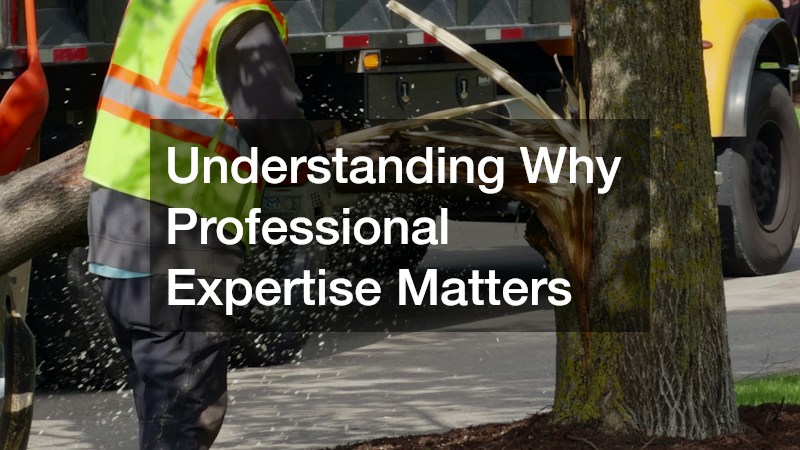
Felling a tree is far more complex than making a single cut at the base. Heavy limbs carry immense tension, and hollow or rotten trunks can split the moment a chainsaw bites into the wood. Professional arborists assess weight distribution, wind direction, and drop zones before making a single cut, often using cranes, ropes, and sectional rigging to lower heavy pieces safely to the ground in tight residential spaces.
Beyond specialized machinery and safety training, reputable tree services carry comprehensive liability and workers’ compensation insurance, shielding homeowners from financial responsibility if an accident occurs. If you spot signs of deep decay, root lifting, severe storm damage, or dangerous proximity to your home, scheduling an assessment for professional tree removal ensures the hazard is handled safely, efficiently, and without unnecessary risk to you or your property.